 COPIER
How Long to Keep Tax Documents (IRS Rules)
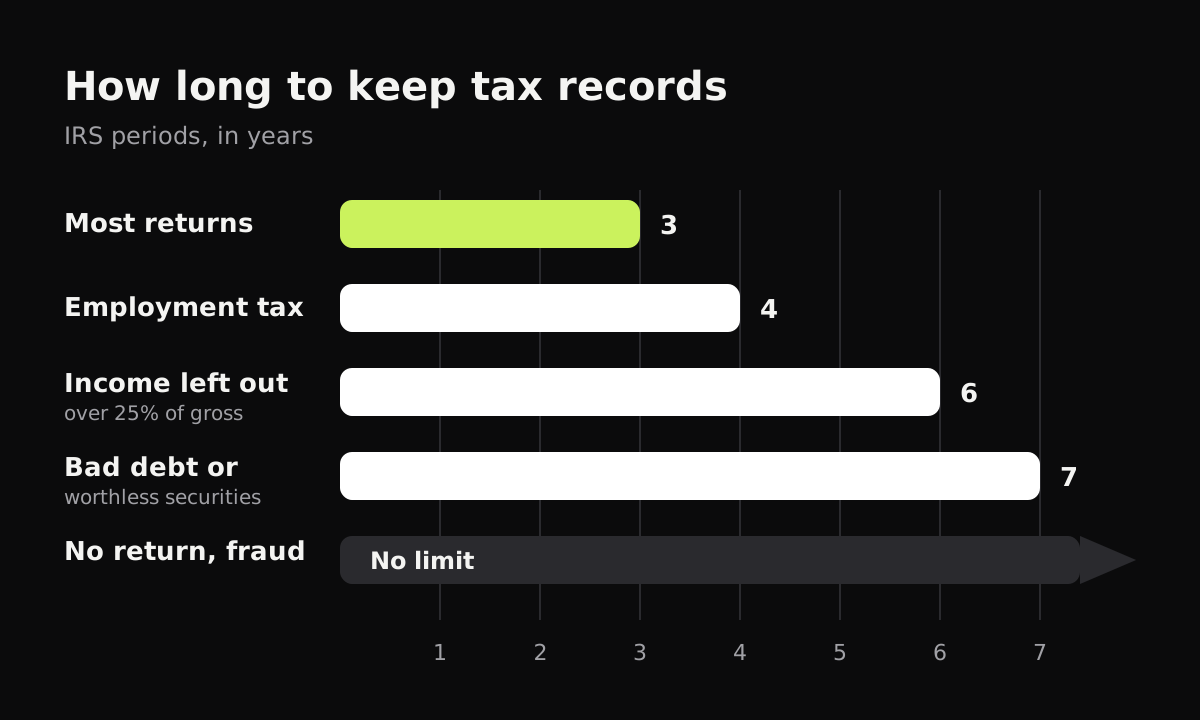
How long to keep tax documents depends on what’s on your return, but for most people the answer is 3 years from the date you filed. The IRS asks for longer in a few cases: 6 years if you left out a large amount of income, 7 years if you claimed a loss on worthless securities or a bad debt, and forever if you never filed or filed a fraudulent return. Records about property you own are kept until 3 years after you sell it, and employers keep payroll records for at least 4 years. These are US federal rules; your state may keep returns open longer.
How long to keep tax records: the IRS periods
The periods come from the IRS page How long should I keep records? and Topic 305, Recordkeeping. Each one is the period of limitations: the time in which you can amend a return to claim a refund, or the IRS can assess more tax. After it ends, the records for that return are generally no longer needed for federal tax purposes.
| Your situation | Keep records for | Counted from |
|---|---|---|
| Most returns (none of the cases below) | 3 years | The date you filed (or the due date, if you filed early) |
| You file a claim for a refund or credit after filing | 3 years, or 2 years after you paid the tax, whichever is later | Filing date, or payment date |
| You left out income of more than 25% of the gross income on your return | 6 years | The date you filed |
| You left out income from foreign financial assets of more than $5,000 | 6 years | The date you filed |
| You claimed a loss from worthless securities or a bad debt deduction | 7 years | The date the return was due |
| You didn’t file a return | Indefinitely | No limit |
| You filed a fraudulent return | Indefinitely | No limit |
| Employment tax records (if you have employees) | At least 4 years | The date the tax was due or paid, whichever is later |
| Records about property (home, shares, equipment) | Until the period ends for the year you dispose of it | The return for the year of the sale |
A worked example
Say you filed your 2025 return in March 2026. Returns filed before the due date are treated as filed on the due date, which for 2025 returns was April 15, 2026. Add 3 years and you can generally shred the receipts behind that return after April 15, 2029, unless one of the longer cases applies.
If you filed late, say in June 2026 on an extension, the 3 years run from June 2026 instead.
How long to keep tax returns
The periods above are about the records that support a return. For the return itself, the IRS says to keep copies of filed returns, because they help you prepare future returns and work out an amended one. A return is a few pages, so many people keep every one for good and only shred the receipts and statements behind it.
Keep W-2s with the return for that year. They’re also proof of your earnings if you ever need to check your Social Security earnings record.
How long to keep property records
Property records are the ones people throw away too soon. If you own a home, keep the closing statement and the receipts for improvements (a new roof, an extension, a kitchen) for as long as you own it, then for the period after the year you sell. The IRS says you need them to work out your basis, which sets the gain or loss when you sell.
The same goes for investments: keep the records of what you paid for shares until the period ends for the year you sell them. If you received property in a nontaxable exchange, the IRS says to keep the records for the old property too, until the period ends for the year you dispose of the new one.
Records you may need longer for other reasons
The IRS page itself makes this point: when records are no longer needed for tax purposes, check whether you need them for something else before you throw them away. Your insurance company or creditors may want them longer. Other common reasons:
- Warranties and big purchases: keep receipts for as long as the warranty or return period lasts.
- Loans and mortgages: a lender may ask for your recent returns.
- State taxes: your state can have its own, longer period. Check its tax agency’s site.
- Business records: your accountant may have a policy of their own.
Scan them and keep less paper
A few years of tax paper fills a drawer. Scans of the same papers fit on a phone, and the IRS accepts electronic copies as long as they are legible and can be stored, found and reproduced when asked. IRS Publication 583 has the detail.
A simple approach:
- Make one folder per tax year, with the return, the W-2s and 1099s, and the receipts for deductions.
- Scan each paper flat and in good light. Use black and white for printed forms; it gives the sharpest text in the smallest file.
- Scan multi-page statements as one document, in order. See how to scan multiple pages into one PDF.
- Name files with the year first, so they sort: “2025 Form 1040 as filed”, “2025 W-2 Employer name”.
- Keep a backup copy on a computer or a drive.
- Write the shred date on the folder: “keep until April 2029”. When the date passes, delete the receipts and keep the return.
For a fuller folder system, and what each receipt should show, see how to scan receipts for taxes.
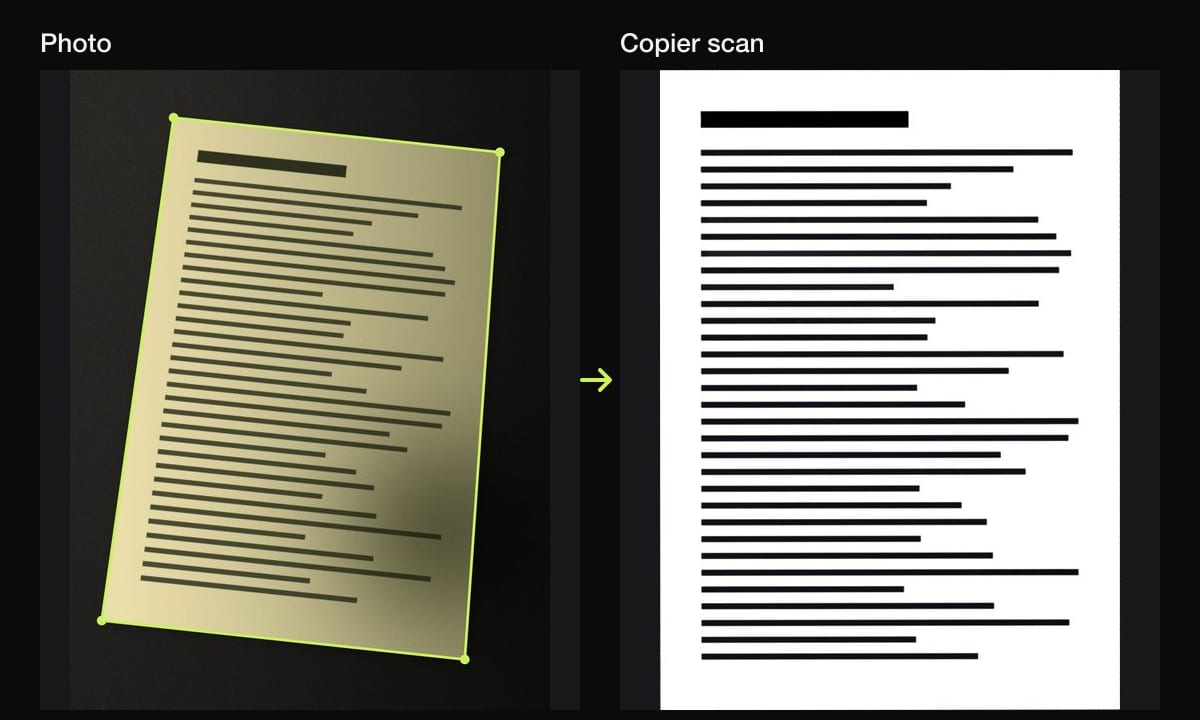
Copier is one way to do the scanning. It finds each page, straightens it, and removes shadows on your phone, and nothing is uploaded or tied to an account, which matters for papers that carry your income and Social Security number. Share pages as JPG for free (up to 10 documents) or as PDF with Copier Pro, a one-time purchase. Copier doesn’t back up to the cloud, so copy your files to your own storage when you’re done.
Which papers to shred, and when
- Every spring, after you file: look at the tax year four years back (in spring 2029, that’s 2025). If none of the longer cases apply, shred its receipts and statements, and keep the return.
- Never on a schedule: property records, records for a year you didn’t file, and anything tied to an open question with the IRS.
- Before you shred: make sure the scan is readable and backed up, and that no lender, insurer or state agency still needs the original.
- Shred, don’t bin. Tax papers carry your Social Security number and account numbers.
If you’re working toward fewer papers in general, how to go paperless covers the rest of the house.
Questions
How long should I keep tax documents?
For most people, 3 years from the date you filed the return, or from the due date if you filed early. Keep them 6 years if you left out more than 25% of your gross income, 7 years if you claimed a loss from worthless securities or a bad debt, and indefinitely if you didn't file or filed a fraudulent return.
Do I need to keep tax returns forever?
The IRS doesn't require it in most cases, but it does recommend keeping copies of filed returns because they help with future returns and amended ones. Many people keep the returns themselves for good and shred the supporting receipts once the period has passed.
How long should I keep records for my house?
Keep records of what you paid for a home and any improvements until the period of limitations ends for the year you sell it. That is usually 3 years after you file the return for the year of the sale.
Can I keep tax records as scans instead of paper?
Yes. The IRS accepts electronic records if they are legible and can be indexed, stored, retrieved and reproduced. Check each scan is readable before you shred the paper, and keep a backup copy.
Do these periods apply to state taxes?
Not necessarily. These are federal IRS rules. Your state may have a longer period to review a return, so check your state's tax agency.